

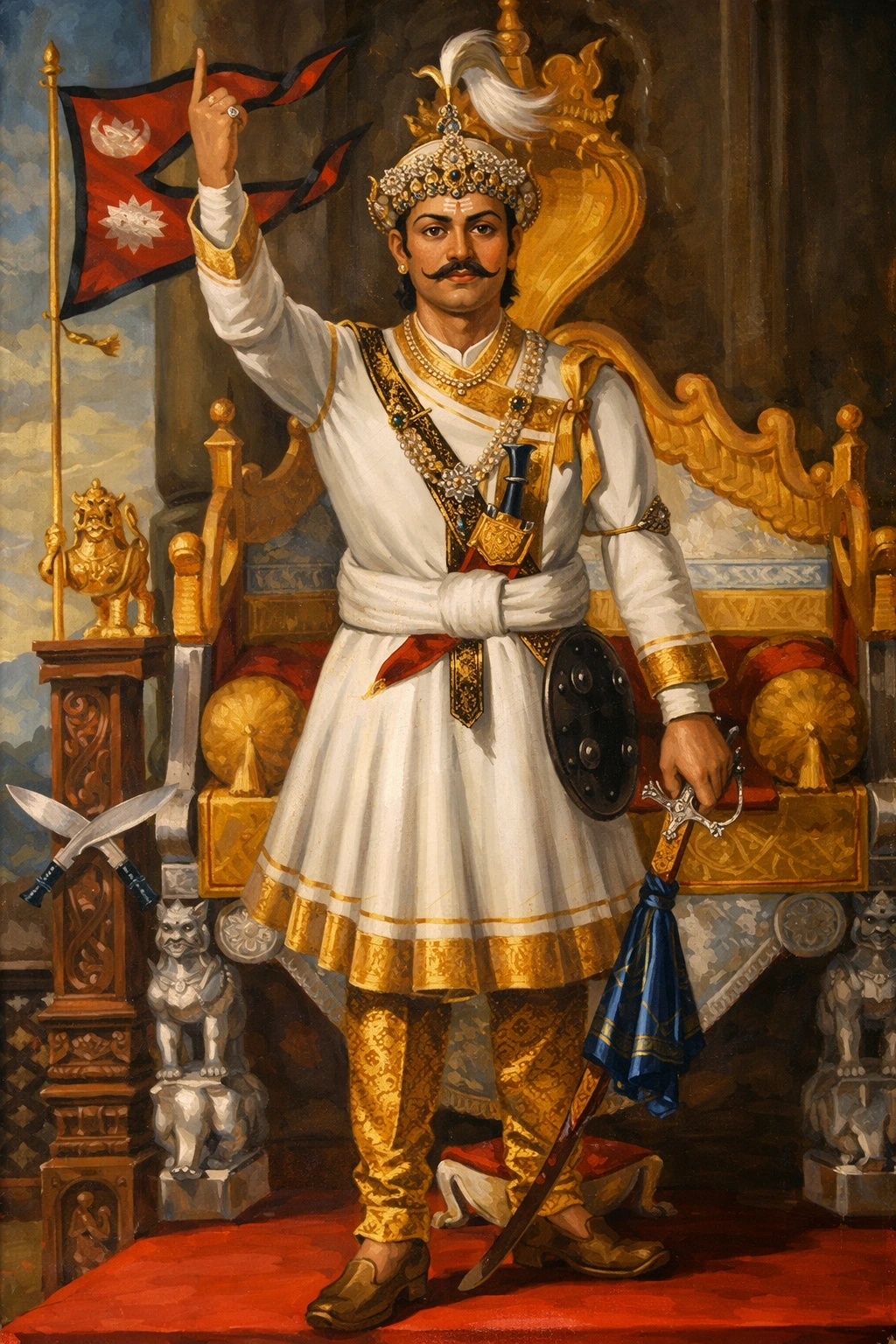
King Prithvi Narayan Shah (1723–1775) is universally recognized as the founder of modern Nepal. A visionary ruler of the Gorkha Kingdom, he successfully unified dozens of small and divided principalities into a single, independent nation. His leadership, military strategy, and political foresight laid the foundation for Nepal’s sovereignty, territorial integrity, and national identity.
Early Life of King Prithvi Narayan Shah
Prithvi Narayan Shah was born in 1723 in the hill kingdom of Gorkha, at a time when Nepal was politically fragmented. The Kathmandu Valley was ruled by the Malla kings, while the western hills were divided among the Baise and Chaubise states. This lack of unity made the region vulnerable to internal conflict and foreign intervention.
From an early age, Prithvi Narayan Shah showed a strong interest in politics, warfare, and diplomacy. His travels—including visits to Banaras—exposed him to regional power dynamics and the growing influence of foreign forces in South Asia. These experiences convinced him that only a unified Nepal could preserve its independence and protect its culture.
Ascension to the Throne of Gorkha
In 1743, Prithvi Narayan Shah ascended the throne of Gorkha. Although Gorkha was a relatively small kingdom, it possessed a disciplined army and a strategically important location. Upon becoming king, he focused on strengthening the military and stabilizing the economy, preparing for a long-term national unification campaign rather than short-term territorial expansion.
Unification of Nepal: Strategy and Military Campaigns
The unification of Nepal under King Prithvi Narayan Shah was marked by patience, careful planning, and strategic brilliance. Instead of relying solely on brute force, he adopted a multi-dimensional approach:
- Strengthened the Gorkhali army through discipline and training
- Captured key hill forts to isolate rival kingdoms
- Controlled major trade routes to weaken enemy economies
- Used diplomacy, alliances, and intelligence where possible
His most significant achievement was the conquest of the Kathmandu Valley in 1768–1769. The capture of Kathmandu, Patan, and Bhaktapur ended Malla rule and brought political legitimacy, economic prosperity, and cultural influence under Gorkhali control. This moment is widely regarded as the birth of modern Nepal.
Political Vision and Divya Upadesh
King Prithvi Narayan Shah was not only a military leader but also a profound political thinker. His teachings, collectively known as the Divya Upadesh (Divine Counsel), articulate his long-term vision for governance, diplomacy, and national survival.
Although Nepal did not have a written constitution during the early Shah period, the principles outlined in the Divya Upadesh functioned as the fundamental unwritten constitutional framework of the Shah dynasty. Successive Shah rulers governed the state largely in accordance with these principles, particularly in matters of foreign policy, sovereignty, economic self-reliance, and internal stability.
King Prithvi Narayan Shah famously described Nepal as a “yam between two boulders,” emphasizing its fragile geopolitical position between powerful northern and southern empires. This metaphor reflected his core political philosophy, which included:
- A balanced and cautious foreign policy
- Protection of national sovereignty
- Economic self-reliance
- Limiting excessive foreign influence
- Promotion of indigenous trade and industries
These guiding principles shaped early Nepalese statecraft and continue to influence modern discussions on Nepal’s foreign policy, national security, and political identity.
Cultural Unity and National Identity
Prithvi Narayan Shah respected Nepal’s ethnic, linguistic, and cultural diversity. While he promoted Hindu traditions, he also emphasized unity among different communities. His policies helped integrate diverse regions into a shared Nepali national identity without erasing local customs, languages, or traditions.
Death and Legacy of King Prithvi Narayan Shah
King Prithvi Narayan Shah passed away in 1775, leaving behind a unified but still-evolving nation. Although his successors continued territorial expansion, his role as the architect of Nepal’s unity remains unparalleled.
- Today, he is remembered as:
- The founder of modern Nepal
- A symbol of national unity and independence
- One of the greatest visionary leaders in Nepalese history
His life, ideas, and achievements continue to be taught in schools, studied by historians, and honored with deep respect throughout Nepal.